Keisuke Naito: Art Collection
List of Works
*Click on the image to enlarge it. Click on the “i” in the bottom right of the enlarged image to see an explanation.

● The sharing of concepts
Title: Memories of Miss G
Size 40P: 1000 x 727 mm Acrylic and collage (later digitally adapted), 1971

A shadow is only cast when there is a real object there. It does not curl or hang down.
● Repeated negation of concepts
Title: Memories of Miss Y
Size 40F: 1000 x 803 mm Acrylic and collage (later digitally adapted), 1971

If you find it uninteresting or don’t understand what it’s about, try reading the English text around the figure.
Do you get a general idea of this woman’s profile?
Don’t you feel there’s something that can’t be expressed by just writing about a woman?
● Sharing concepts through written words
Title: Memories of Miss S
Size 40F: 1000 x 803 mm Acrylic and collage (later digitally adapted), 1971

For some reason, the silhouette casts a shadow that hangs down, revealing the true image of a beautiful woman.
Consider once more the meaning of the words and the image as a whole.
The repetition of illusion and the development of reality.
● Negation of concepts and sharing of the concepts of written words
Title: Memories of Miss A
Size 50F: 1167 x 910 mm Acrylic and collage (later digitally adapted), 1972
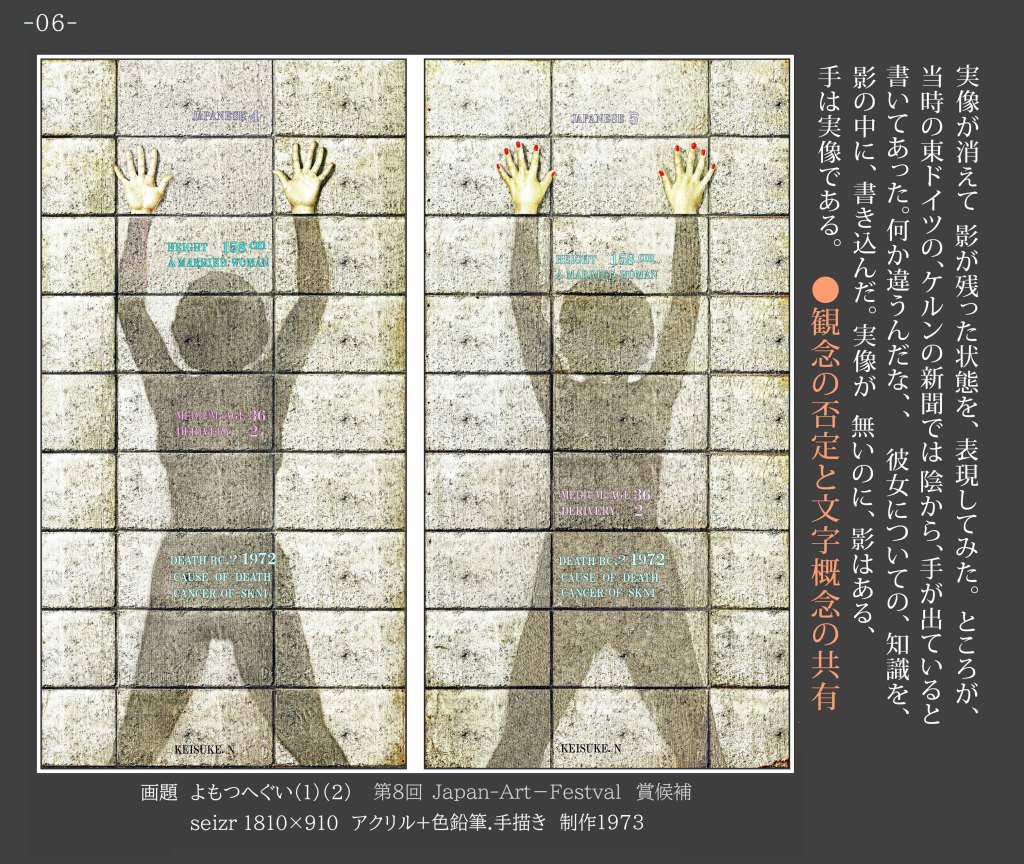
Something is off… I wrote what knowledge I had of her within the shadows.
Although the actual person is not there, the shadow is there, and the hands are real.
● Negation of concepts and sharing of written concepts
Title: Yomotsuhegui (Dining in the Underworld) (1) (2) Nominated for the 8th Japan Art Festival Award
Size 1810 × 910 mm Acrylic and colored pencil, hand-drawn, 1973

The feminine footprints must surely be those of a slender beauty.
Even if the person is not shown, the viewer can develop the picture according to their own preferences.
It is no longer in the hands of the artist.
● Considering watering a tree = Concept
● Fetching water and pouring it on the tree = Action
● The tree does not wither = Result
Concept as purpose
Composition of conceptual art
Action Result
● Traces of action
Title: Water Faucet, 1973 Exhibited at the Japan International Art Exhibition (Mainichi Newspaper)
Size 100P: 1620 x 1303 mm Acrylic paint, hand-painted, 1973

The viewer is trying hard to understand what is there by feeling their way around.
● Understanding actual circumstances and confirming reality
Title: Lemon, 1973 Exhibited at the 20th Shell Art Award Exhibition
Size 50F: 1167 x 910 mm Acrylic and colored pencil, 1973

Another child reacts instead with anger. The adults pause in a moment of bewilderment.
The balloon does not have the strength to lift the heavy old woman, sitting so composed.
It defies the concept of immutability.
● The act of negating a concept
Title: Grandma Won’t Fall, 1975 Exhibited at the Japan International Art Exhibition (Mainichi Newspaper)
Size 80F: 1455 x 1120 mm Acrylic and colored pencil, hand-drawn, 1975

● Negation of concepts
Title: The Blocks Won’t Fall
Size 80F: 1455 x 1120 mm Acrylic and colored pencil, hand-drawn, 1975

It’s a bizarre situation. Being bolted to the space, the scale is reduced to a flat surface.
Thus, the two ants in the middle can naturally stay in the space.
A fictional world where plane and space are placed in the same dimension.
● Negation of the space of concepts
Title: Weighing Ants, 1991 Exhibited at the Emba Art Prize Exhibition
Size 80F: 1455 x 1120 mm Acrylic and colored pencil, hand-drawn, 1981

Work 81-1 From the 15th Contemporary Art Exhibition of Japan 2
113 x 147 cm Canvas, oil paint, acrylic, etc.
A balloon, a concrete block, and a cabbage are all floating in the air. Does this depict a state of zero gravity? Not so. A real chain hanging from the protrusions above the one child standing alone on the right clearly demonstrates that heavy objects will always fall due to gravity.
So what kind of prank is this?
It’s no prank. The picture gives off a cool sense of artistic triumph by presenting a weighty motif in a casual manner to pique the viewer’s curiosity. Why do we believe that balloons float but concrete blocks and cabbages cannot? The picture contains an allegory about questioning whether it is really okay to trust the conventions of society. The artist places ordinary objects in extraordinary circumstances. It is a puzzle that challenges us to open our eyes, to not settle for the ordinary, and to change the angle from which we view things.
Yet even if we decipher that meaning, there’s still something strange about this picture. The children also, each covering their mouth with one hand, are posed as if to say, “Oh, that’s weird.”
The very appearance of the painting, which depicts impossible things, is humorous. The picture gives of a cool sense of artistic triumph by presenting a weighty motif in a casual manner to pique the viewer’s curiosity.
Amazingly, though the four identical children appear to be photographic transfers, they are actually hand-drawn in colored pencil. This was achieved by carefully filling in each point on a finely divided grid. Both the block and the cabbage have texture very similar to the real thing. It is precisely because the picture is created in a mechanical way with such painstaking effort that it achieves a realistic effect, like a photo from a glossy magazine. (Sadao Kato) = Article continues within.
The 15th Contemporary Art Exhibition of Japan is being held at the Tokyo Metropolitan Art Museum in Ueno Park, Tokyo, until May 12th (closed on Mondays). Admission fees are 600 yen for adults, 400 yen for university and high school students, and 200 yen for elementary and junior high school students (100-yen discount each for groups of 20 or more and advance tickets).
The balloon, the cabbage, and the block are all floating.
The three-dimensional space is undeniably mysterious.
There are bolts driven into the top right of the canvas and a chain hangs between them.
This is the act of transforming spatial depth into a flat plane.
The boundary between the three-dimensional and the two-dimensional
● Rejection of the space of notions
The incident in which Mr. XX of the Aichi Prefectural Museum of Art rejected the purchase the work and the award was suddenly revoked. According to Mr. Kato, Literature Department Director

● Rejection of the space of notions
Title: The Children of the Fujii Household, 1981 Exhibited at the Contemporary Art Exhibition of Japan (Mainichi Newspaper), award withdrawn
Size 80F: 1455 x 1120 mm Acrylic and colored pencil, hand-drawn, 1981

But, Mr. Fujii’s child is standing at the same angle as the embankment.
This is odd; anyone would think it’s weird. Because it is outside our concept of reality. Children can see ahead with peace of mind.
● Rejection of notions
Title: The Children of the Fujii Household (2)
Size 25F: 803 x 803 mm Acrylic and colored pencil, 1983

It’s a normal three-story apartment building, but something off!
The residents! They defy common sense, which means they fall outside our concept of normality.
● Rejection of notions
Title: Residents of Aobaso (1)
Size 80F: 1455 x 1120 mm Acrylic and colored pencil, hand-drawn (later digitally adapted), 1984

In this picture, the empty room is quiet, but there is also half a fish, jizo lanterns, a scrapped car, and even an elephant’s butt. A single building. A quiet scene.
● A scene of rejection of notions
Title: Residents of Kuretakeso (1), 1982 Exhibited at the Japan International Art Exhibition (Mainichi Newspaper)
Size 100P: 1620 x 1303 mm Acrylic and colored pencil, hand-drawn (later digitally adapted), 1984

The old man walking and the girl seem fine. As Mr. XX said, don’t draw a sloppy picture! This picture doesn’t need any unique expression. There are simply things that should not exist, right there.
● Existence that rejects notions
Title: Residents of Kuretakeso (2)
Size 80F: 1455 x 1120 mm Acrylic and colored pencil, hand-drawn (later digitally adapted), 1984

Title: Residents of Hinodeso (1)
Size 80F: 1455 x 1120 mm Acrylic and colored pencil, hand-drawn (later digitally adapted), 1984

There are simply things that should not exist, right there.
● Existence that rejects notions
Title: Residents of Kuretakeso (2)
Size 80F: 1455 x 1120 mm Acrylic and colored pencil, hand-drawn (later digitally adapted), 1984

● Rejection of notions
Title: Residents of Hinodeso (2)
Size 80F: 1455 x 1120 mm Acrylic and colored pencil, hand-drawn (later digitally adapted), 1984

● The big sale of the rejection of notions
Title: Residents of Hinodeso (3)
Size 80F: 1455 x 1120 mm Acrylic and colored pencil, hand-drawn (later digitally adapted), 1984

There is no one who would doubt or reject the numbers on a house’s blueprints.
So, this should increase the reality of the building in the drawing and create sense of realism. But this is where the residents appear and reject our notions of reality.
● The use of notions and the rejection of notions
Title: Sanshu Kato Design Office
Size 80F: 1455 x 1120 mm Acrylic and colored pencil, hand-drawn (later digitally adapted), 1984

● The sharing and rejection of notions
● The difference between concepts and notions
● Concept: Looking at a lighter and seeing a tool for lighting a fire
● Notion: Grasping the lighter and producing fire!
Title: Residents of an Old Castle, 1983 Exhibited at the Japan International Art Exhibition (Mainichi Newspaper)
Size 80F: 1455 x 1120 mm Acrylic and colored pencil, hand-drawn (later digitally adapted), 1983

● A scene of rejection of notions
Title: One of the Eight Views of Mt. Fuji (1)
Size 15F: 652 x 530 mm Pencil on paper, hand-drawn, 1985

● A scene of rejection of notions
Title: One of the Eight Views of Mt. Fuji (7)
Size 15F: 652 x 530 mm Pencil on paper, hand-drawn, 1985

A fish pulls, a balloon lifts, a cat tugs. The setup is unstable and the house will soon collapse. All this action is not within our concept of normality.
● Actions of the near future based on the rejection of notions
Title: Bringing Down the House (1) Wakayama Art Award Exhibition, Excellence Award recipient
Size 80 modified: 1455 x 1110 mm Acrylic and colored pencil, hand-drawn (later digitally adapted), 1985

Bringing down a house in a ridiculous and impossible way. The letters in the picture are meant to reaffirm the objects depicted.
● Existence that rejects notions, actions of the near future
Title: Bringing Down the House (2) Wakayama Art Award Exhibition, Excellence Award recipient
Size 80 modified: 1455 x 1110 mm Acrylic and colored pencil, hand-drawn (later digitally adapted), 1985

Bringing down a house in the most ridiculous way. It won’t collapse so long as you are looking at it. It will collapse when no one is around.
● Rejection of perverse notions, actions of the future
Title: Bringing Down the House (3), 1986 Exhibited at the Contemporary Art Exhibition of Japan (Mainichi Newspaper)
Size 80 modified: 1455 x 1110 mm Acrylic and colored pencil, hand-drawn (later digitally adapted), 1986

Such a scenario could never happen. This is a fantasy game in my head. A game that involves playing with the principles of gravity.
● Playing with the rejection of notions
Title: Weighing Grandpa
Size 80 modified: 1455 x 1110 mm Acrylic and colored pencil, hand-drawn (later digitally adapted), 1986

● Rejection of notions, actions of the near future
Title: Cracking an Egg, 1989 Exhibited at the Contemporary Art Exhibition of Japan (Mainichi Newspaper)
Size 80 modified: 1455 x 1110 mm Acrylic and colored pencil, hand-drawn (later digitally adapted), 1989

● Rejection of purpose and outcome
Title: Dropping a Rock, 2009 48th Hokuriku Chunichi Art Exhibition, Best 4 Excellence Award recipient
Size 80 modified: 1455 x 1110 mm Acrylic and colored pencil, hand-drawn (later digitally adapted), 1989

The man on the bottom left is not involved in this incident. The act of lifting a rock in an impossible and absurd way, without pursuing any purpose or outcome. Simply pulling on the strings without a care.
● Rejection of notions, setting and actions
Title: Raising a Rock (1)
Size 80 modified: 1455 x 1110 mm Acrylic and colored pencil, hand-drawn (later digitally adapted), 1990

One of them is even flying the moon. There is also a fish. And a man reading a newspaper. The fish swims in the moonlit sky — a crossing of dimensions. A rock that shouldn’t float is floating. A large rock that exists in a fictional space.
● Interplay of rejection of notions and acts of reality
Title: Raising a Rock (2)
Size 100P: 1620 x 1303 mm Acrylic and colored pencil, hand-drawn (later digitally adapted), 1992

● The existence of notions and the act of rejection
Title: Raising a Rock (3)
Size 100P: 1620 x 1303 mm Acrylic and colored pencil, hand-drawn (later digitally adapted), 1992

Since it has a well, the rock must be large indeed. Since the butterfly is flying, it must be in a three-dimensional space.
Are the people floating in the sky? This absurd space is a fictional realm.
● A game of rejecting notions
Title: Raising a Rock (4)
Size 100P: 1620 x 1303 mm Acrylic and colored pencil, hand-drawn (later digitally adapted), 1992

● A grand performance of rejecting notions
Title: Night at Tokiwaza
2010 Nagakute Culture Center Picture Competition, Grand Prize recipient
Size 25S: 803 x 803 mm Colored pencil on paper (later digitally adapted), 1996

This reflects my personal notions. From the many years of accumulated work, the staff of characters I’ve illustrated up until now are brought back to life.
They act independently, outside the bounds of common sense. A surreal theater of heroes. This is the second in a series.
● An ensemble of rejection of notions
Title: Night at Tokiwaza (2)
Size 25S: 803 x 803 mm Colored pencil on paper (later digitally adapted), 1997

● The fusion of different dimensions through the rejection of notions
Title: Let Me, Show You
Size 50 modified: 1167 x 1098 mm Digital painting (Adobe Photoshop), 2011

● The rejection of notions and the overlapping of perspectives
Title: Bamboo’s Mom’s Nap (1)
Size 50 modified: 1167 x 1098 mm Digital painting (Adobe Photoshop), 2012

The right and left hands do not share the same space. The photo in the center occupies a space in a different dimension. The left hand is actually the right hand.
The interplay of space emphasizes the illusion. Marlene Dietrich was a silver screen icon from long ago.
● Illusions caused by the intertwining of notions
Title: Marlene Dietrich
Size 50 modified: 1167 x 1098 mm Digital painting (Adobe Photoshop), 2013

● Overlapping of the spaces of notions
Title: Bamboo’s Mom’s Nap (2)
Size 50 modified: 1167 x 1098 mm Digital painting (Adobe Photoshop), 2014

● Illusions of the Ancient Capital
● Rejection and repeated manipulation of the concept of space
Title: Revelry of the Upāsikās (2)
Size 80 modified: 1455 x 1045 mm Digital painting (Adobe Photoshop), 2019

Perspective A
Perspective B
AD-2023
● Repeated manipulation of the rejection of notions
Title: Revelry of the Upāsikās (2)
Size 80 modified: 1455 x 1045 mm Digital painting (Adobe Photoshop), 2019


It took me quite some time to come to the conclusion that conceptual art is the correlation between notions, actions, and existence.
I also considered conceptual art to be merely a means of expression, primarily for the expression of individuality. Although the act of drawing begins as a sensory-driven process, my work does not truly take shape unless I allow the logic of those notions to run alongside it.
I submit a rejected painting to another competition. Under the same judges, it wins an excellence award.
A work that was rejected 10 years ago wins an award at a new competition.
Had the world caught up with me? Was I simply waiting for my time?
I gained a little more confidence. Now, 50 years later, I’ve been left behind.
Time repeats in a spiral, so I’ll wait for the moment when the world appreciates me once again.
I have no idea what young people are drawing these days. That’s something we were often told when we were young. Differences in perception due to generational differences and the passage of time are unavoidable.
However, among contemporary artists, there are quite a few whose works I find deeply moving. If you look closely, you’ll see that the artists skillfully use drawing techniques based on conceptual logic rather than intuition. And yet, the artists themselves have no knowledge of the history of conceptual art. These days, conceptual art has become like underwear that we wear unconsciously. There are also some self-important artists who wear no underwear at all.

● Not in the style of Western painting, but in my own style
Title: Tranquility of Nirvana Image Tama Art University graduation work, second place, broadcast on NAK Television.
Size 50 × 2: 2334 × 803 mm Oil on canvas (later digitally converted to monochrome), 1949

● Using Japanese brushes to create Eastern spatial aesthetics
Title: Revelry of the Upāsakas Exhibited at the 1st Japan Association for Young Artists Exhibition
Size 100P: 1620 x 1303 mm Oil painting (later digitally adapted), 1947

In a corner of an old temple lie several battered statues of Buddha with their hands, feet, and heads missing. Over the course of time, these statues of Buddha have witnessed the interactions, the crying, the shouting, and the laughter of many different people. Standing quietly, unspeaking, over many years, until their bodies are worn down.
● Expressing emotions through abstract space
Title: Pilgrimage to Ancient Temples (1)
Size 80P: 1455 x 970 mm Oil painting (later digitally adapted) Year of production: unknown (1957-1960?)

I want to connect with the image, but I keep filling up the canvas. I was fascinated by the footprints of the Buddha’s, images of Nirvana, and Sanskrit scriptures.
● Expression through semi-figurative work
Size 100F: 1620 x 1303 mm Oil painting (later digitally adapted) Title: Pilgrimage to Ancient Temples (3) Year of production: unknown (1957-1960?)

The lines and shapes that remain on the canvas lose all meaning. Though this doesn’t create a picture, the lines and shapes remain. This was the first time that I had had such an experience. This refreshing, relaxing, and pleasant moment.
● The era of Informalism is close at hand
Title: Pilgrimage to Ancient Temples (4)
Size 80P: 1455 x 970 mm Oil painting (later digitally adapted) Year of production: unknown (1957-1960?)

● Semi-figurative and semi-abstract expression
Title: Upāsaka (A)
Size 40F: 1000 x 803 mm Oil painting (later digitally adapted) Year of production: unknown (1948-1958?)

● My only surviving three-dimensional work
Title: Pilgrimage to Ancient Temples (2)
Size 30 modified: 910 x 827 mm Relief (sawdust and cement) Year of production: unknown (1958?)

● Outdated abstract expression
Title: Pilgrimage to Ancient Temples (5)
Size 60F: 1303 x 970 mm Paper clay texturing and acrylic paint Year of production: unknown (1957-1960?)

● Abstract representation of a journey through Nara
Title: Pilgrimage to Ancient Temples (6)
Size 60S: 1303 x 1303 mm Paper clay texturing and acrylic Year of production: unknown (1957-1960?)

● Abstract expression in remembrance of a tomb’s occupant
Size 60F
Title: Pilgrimage to Ancient Temples (8)
1303 x 970 mm Paper clay texturing and acrylic paint Year of production: unknown (1957-1960?)

This is the seventh piece in a series of paper clay works. My thoughts drift to a cool mornings in Asuka and the events of the Isshi Incident.
● Abstract expression of association and emotion
Title: Pilgrimage to Ancient Temples (7)
Size 60 modified: 1303 x 1203 mm Paper clay texturing and acrylic Year of production: unknown (1957-1960?)

● Abstract expression that evokes ancient tombs
Title: Pilgrimage to Ancient Temples (9)
Size 60F: 1303 x 970 mm Paper clay texturing and acrylic paint Year of production: unknown (1957-1960?)

A single out-of-season hydrangea blooms on a small fragment of a wooden grave tablet.
Who placed it there, in a back alley so barren not even a blade of grass grows?
In my own colors and my own forms, it came together quite nicely.
An unsold piece from a collection of paintings for sale.
● Change — conceptual art is coming
Title: Pilgrimage to Ancient Temples (10)
Size 30S: 910 x 910 mm Paper clay texturing and acrylic paint Year of production: unknown (1957-1960?)

Is it a bulb crawling across barren soil? Or a scorched, blackened burlap sack? No, it’s nothing like that. Please don’t think about it in concrete terms.
Just feel it honestly, as you see it. These amorphous shapes and lines — let them stir something in you.
● Outdated abstract expressionism
Title: Pilgrimage to Ancient Temples (11)
Size 30S: 910 x 910 mm Paper clay texturing and acrylic paint Year of production: unknown (1957-1960?)

● Abstract expression that relies on sensitivity
Title: Pilgrimage to Ancient Temples (11)
Size 30S: 910 x 910 mm Paper clay texturing and acrylic paint Year of production: unknown (1957-1960?)

I’m quite fond of this cliff-like arrangement. It’s my attempt to express the emotional impact I felt when I encountered the eerie allure of the cliffside Buddhas of Kunisaki Peninsula in Oita Prefecture. This is the final piece in my journey of pilgrimage to ancient temples and tombs.
●Abstract expression through encounters with the allure of the mysterious
Title: Pilgrimage to Ancient Temples (12)
Size 30S: 910 x 910 mm Paper clay texturing and acrylic paint Year of production: unknown (1957-1960?)

● The rejection of notions and the existence of notions
Title: Obon Festival
Size 60 modified: 1303 x 1203 mm Canvas and acrylic paint, 1970

● Semi-figurative representations of daemons
Title: Upāsaka (B)
Size 60F: 1303 x 970 mm Canvas and acrylic paint Year of production: unknown (1957-1960?)

While expressing celebration with the red and white ribbons, I depicted Okinawa as suspended by them — indicating that it yet remains constricted. The piece was soundly rejected for being too socially charged. Bravo. Bravo.
● Expression of meaning through figurative art
Title: Okinawa — Return to Japan
Size 60F: 1303 x 970 mm Canvas and acrylic paint Year of production: unknown (1957-1960?)

● Illusionary memories that transcend logic and consciousness
Title: The Upāsikā Comes (1)
Size 30 modified: 910 x 810 mm Cardboard and acrylic paint Year of production: unknown (1967-1969?)

It is a time and space of daemonic essence that transcends theory and consciousness.
● A dimension of daemonic essence beyond theory and consciousness
Title: The Upāsikā Comes (2)
Size 30 modified: 910 x 810 mm Cardboard and acrylic paint Year of production: unknown (1967-1969?)

Slightly cartoonish, with eroticism restrained and a touch of daemonic eeriness subtly emphasized. The costume is vivid, with complementary colors. The stage is simple and pure.
● Daemonic vitality that surpasses desire
Title: The Upāsikā Comes (3)
Size 30S: 910 x 910 mm Cardboard and acrylic paint Year of production: unknown (1957-1960?)

The upāsikā becomes a star. She emerges from the darkness of prayer. The moon casts its soft light within an eerie sky.
The dark night sky is perfectly clear. Perhaps it’s time to vanish — into the dimension of prayer, the realm of daemonic beings, the place where living souls are laid to rest.
● A daemonic dimension, expressed through figurative art
Title: The Upāsikā Comes (4)
Size 30 modified: 910 x 810 mm Cardboard and acrylic paint Year of production: unknown (1967-1969?)

● Semi-figurative expression based on the absurdity of the unconventional
Title: The Upāsikā Comes (5)
Size 30 modified: 910 x 810 mm Cardboard and acrylic paint Year of production: unknown (1967-1969?)

No, that’s not right. I erase it, then paint again. Gradually, the image takes hold.
A painting cannot be born from theory alone, but a painting without theoretical grounding is even weaker. Were the only survivors the saint’s entrails? Or is this This thing that grows like mold a daemonic being?
● Daemonic presence, semi-figurative expression
Title: The Upāsikā Comes (5)
Size 30 modified: 910 x 810 mm Cardboard and acrylic paint Year of production: unknown (1967-1969?)

The monk’s eyes are blank. The divinatory mudra is bound by thread. Time and space are stolen away by these beings. Can a daemonic dimension be contained within the bounds of common sense?
I don’t simply paint what comes to mind. I paint to search. And in that searching, a method of exploration begins to form.
● Exploration of imagery and abstract expression
Title: Upāsaka (C)
Size 30 modified: 910 x 810 mm Cardboard and acrylic paint Year of production: unknown (1967-1969?)

● Figurative expression of scenes of remembrance
Title: Upāsaka (D)
Size 60 modified: 1303 x 1137 mm Cardboard and acrylic paint Year of production: unknown (1967-1969?)

In the depths of the earth, faint smiles flicker across every face. The daemonic forces of the heavens kindle the quiet, dusky dawn. Come now — let us journey to Mount Potalaka. Lured by you, who wanders through the skies.
● Figurative expression of passion
Title: Upāsaka (D)
Size 60 modified: 1303 x 1137 mm Cardboard and acrylic paint Year of production: unknown (1967-1969?)

● Reminiscence of emotion, figurative expression
Title: Upāsaka (D)
Size 60 modified: 1303 x 1137 mm Cardboard and acrylic paint Year of production: unknown (1967-1969?)

● Figurative expression of memories and illusion
Title: Upāsaka (E)
Size 60 modified: 1303 x 1137 mm Cardboard and acrylic paint Year of production: unknown (1967-1969?)

● Figurative expression of passion
Title: The Leech Maiden Forms a Hidden Mudra and Departs for Hongō
Size 60S: 1303 x 1303 mm Cardboard and acrylic paint Year of production: unknown (1967-1969?)

● Semi-figurative expression of the unconscious
Title: Birth of the Upāsaka
Size 60S: 1303 x 1303 mm Cardboard and acrylic paint Year of production: unknown (1967-1969?)

● Figurative expression of emotion and feeling
Title: Holy Avalokiteśvara Bodhisattva
Newspaper 545 × 408 mm Ink and brush on newspaper Year of production: unknown (1957-1960?)

His ink-dyed robes, utterly soiled. What is he thinking? Moved by a spark of feeling, I draw spontaneously. The broken tip of my pencil races across the paper. Chasing an elusive daemonic essence leads me to an unexpected encounter with this holy man. I’m glad we met.
● Encountering daemonic essence through figurative expression
Title: The Upāsaka Sets Out
Size A4: 297 × 210 mm Pencil on paper Year of production: unknown (1948-1958?)

● A completely ordinary drawing
Title: Miss A, in Shibuya
Size 4F: 333 x 253 mm Canvas and oil paint Year of production: unknown (1957-1960?)

This is an image I captured from her appearance on the TV show 11PM, which I then drew by hand. It’s not something I’d normally include in an art book, but I just wanted people to see it. If you’re a fan of Etsuko Mai, I think you’d want this one, wouldn’t you?
● A piece that isn’t even art
Title: Mai Etsuko-san
Size A4: 297 × 210 mm Pencil on paper Year of production: unknown (1948-1958?)

But I wanted to show one of my behind-the-scenes techniques as an artist. This was as a preliminary study for a commissioned piece, sketched while referencing magazines, noting down expressions. Since it’s a rough draft, it’s simply a memory sketch capturing facial expression.
● Capturing expressions swiftly
Title: Croquis (A)
Size A4: 297 × 210 mm Pencil on paper Year of production: unknown (1948-1958?)

● Even in precise imitation, personality emerges
Title: Gravure Magazine Copy (A)
Size A4: 297 × 210 mm Pencil on paper Year of production: unknown (1948-1958?)

Why lift a rock? There’s no reason.
● The notion of purpose and its rejection
Title: Moonlit Night — Lifting a Stone
Size A4: 297 × 210 mm Pencil on paper Year of production: unknown (1990-2000?)

This is a mandala that belongs to no sect. It is mine, and mine alone. People live through connection, through the help of others. By recognizing and affirming those presences, life takes shape. When I peer into my own heart, there, my mandala resides.
● Affirming my life — my mandala
Title: Mandala — BU.6482
Size 40 modified: 1000 x 950 mm Acrylic and pencil Year of production: unknown (1948-1958?)

This piece is one of twelve original drawings I created for that purpose. To make it suitable for relief carving, the lines are drawn clearly, and the height differences on the surface are emphasized — hallmarks of tile art craftsmanship.
● Original tile art drawing: Year of the Snake
Title: The Arrival of Yatonokami
Size A4: 297 × 210 mm Pencil on paper Year of production: unknown (1948-1958?)

● A simple work with strong presence
Title: Asahi-so Apartment
Size A4: 297 × 210 mm Pencil on paper Year of production: unknown (1948-1958?)

● This foolish monk is a disciple of Gyoki
Title: Upāsaka (B)
Size A4: 297 × 210 mm Pencil on paper Year of production: unknown (2015-2018?)

● A sensibility that brushes across the mind
Title: Obon Festival (2)
Size A4: 297 × 210 mm Pencil on paper Year of production: unknown (2015-2018?)

Though it’s an unfinished work, I couldn’t bring myself to discard it. In the end, I was attached to this woman. I kept thinking I’d finish it someday. I’ve struggled with expressing the theater curtain and the depth behind it.
● A portrayal of lingering attachment in a painting meant for sale
Title: Croquis (2)
Size A4: 297 × 210 mm Pencil on paper Year of production: unknown (2015-2018?)

I kept the eroticism to a minimum, aiming instead for a warm, tender feeling.
● Restrained eroticism
Title: Croquis (3)
Size A4: 297 × 210 mm Pencil on paper Year of production: unknown (2015-2018?)

The intertwining of the dragon and celestial maiden is a classic motif, deeply rooted in the traditions of the tile-making world.
● A time-honored theme in the tile industry
Title: Dragon God and Shrine Maiden
Size: 280 × 280 mm Pencil on paraffin paper (reproduction), 2012

The original was designed to facilitate creation of the ornamental tile. I gave it just a slight hint of S&M.
● A pursuit of serene eroticism
Title: Yatonokami and Shrine Maiden
Size: 280 × 280 mm Pencil on paraffin paper (reproduction), 2013

● Original design for an ornamental roof tile
Title: Celestial Horse Flying with Goddess
Size: 280 × 280 mm Pencil on paraffin paper (reproduction), 2014

● Fantasy and imagination
Title: Celestial Maiden Frolicking with Sheep
Size: 280 × 280 mm Pencil on paraffin paper (reproduction), 2015

● Original drawing for a zodiac tile – Year of the Monkey
Title: Celestial Maiden Dancing with the Elder Monkey
Size: 280 × 280 mm Pencil on paraffin paper (reproduction), 2016

● A once failed artist makes a livelihood as a design illustrator.
Title: Celestial Maiden Descending on a Rooster
Size: 280 × 280 mm Pencil on paraffin paper (reproduction), 2017

Long ago, the beautiful Seyadatara-hime was relieving herself in a latrine, when the god Omononushi, having transformed into a vermilion-painted arrow, flowed down the channel and pierced her genitals. Startled, the maiden retrieved the arrow and placed it beside her bed. The arrow then transformed into a splendid man, and the two became husband and wife.
No one has ever depicted this myth in art. This simple fantasy now feels burdensome to us. A commission rejected by a famous painter found its way to me, an unknown artist. I had no choice but to accept. Who placed the order?
● Ancient fantasy
Title: Omononushi no Kami and Seyadatara-hime
Size A4: 297 × 210 mm Pencil on paper Year of production: unknown (1948-1958?)

People should live as humans. Kukai says, “Be an unfinished Tathāgata — not yet fully enlightened.” The piece sold.
It received a respectable evaluation and price. Namu Butsu.
● A world of desire and illusion
Title: Buddha — Unfinished Tathāgata
Size A4: 297 × 210 mm Pencil on paper Year of production: unknown (1948-1958?)

Born in 1936 (Year of the Rat), near Anjo Castle in Mikawa Province, from a family line of poor peasants.
1945 (Year of the Rooster), age 9: Experienced the Tonankai Earthquake and Japan’s defeat in the Pacific War; attended third grade of elementary school.
1954 (Year of the Horse), age 18: Graduated from Aichi Prefectural Kariya High School and entered Tama Art University (graduated in 1959).
1956 (Year of the Monkey), age 20: Two-person exhibition with Masao Tsurumi at Saoh Gallery.
1956 (Year of the Monkey), age 20: Participated in the founding of the Youth Artists Association; exhibited in its first group show at Nihon Gallery in Ginza.
1957 (Year of the Rooster), age 21: Solo exhibitions held in 1957 at Saoh Gallery, 1959 at Kunugi Gallery, 1960 at Muramatsu Gallery, 1966 at Kunugi Gallery, 1967 at Saoh Gallery, and in 1970 and 1971 at Nihon Gallery.
1960 (Year of the Rat), age 24: Exhibited at the Yomiuri Independent Exhibition, Tokyo Metropolitan Art Museum.
1960 (Year of the Rat), age 24: Chosen for select exhibition at Kunugi Gallery, along with Masao Iwama and Yatsuo Nonaka.
1968 (Year of the Monkey) age 32: Awarded Grand Prize at the 11th Shinsho Exhibition; recommended for Associate Membership.
1969 (Year of the Rooster), age 33: Selected as a member at the 12th Shinsho Exhibition; exhibited annually thereafter.
1973 (Year of the Ox), age 37: Nominated for Japan Art Festival Award; touring exhibition in East Germany (Cologne) and Yugoslavia.
Requested for inclusion in Cologne City Art Museum; given photo feature and accolades in local newspaper. Invited exhibitors: Masuo Ikeda, Nobuo Sekine, and Jiro Takamatsu.
1973 (Year of the Ox), age 37: Selected for Shell Art Award Exhibition.
1973 (Year of the Ox), age 37: Selected for the Contemporary Art Exhibition of Japan (Mainichi Newspaper); selected also in 1981 and 1985.
1982 (Year of the Dog), age 46: Selected for the Japan International Art Exhibition (Mainichi Newspaper); selected also in 1988 and 1990.
1984 (Year of the Rat), age 48: Two-person exhibition with Minoru Yamada at Gallery Center Point.
1989 (Year of the Snake), age 53: Received the Excellence Award at the Wakayama Art Grand Prize Exhibition; selected for the Emba Art Award Exhibition.
1991 (Year of the Sheep), age 54: selected for the Emba Art Award Exhibition and received honorable mention in the ABC Illustration Contest.
1992 (Year of the Monkey), age 56: Experimental project — Contemporary Art Exchange Exhibition in Yokohama, held at Kanagawa Kenmin Hall.
1993 (Year of the Rooster), age 57: Served as president of the Shinsho Artists Association for three years (office located in Tabata).
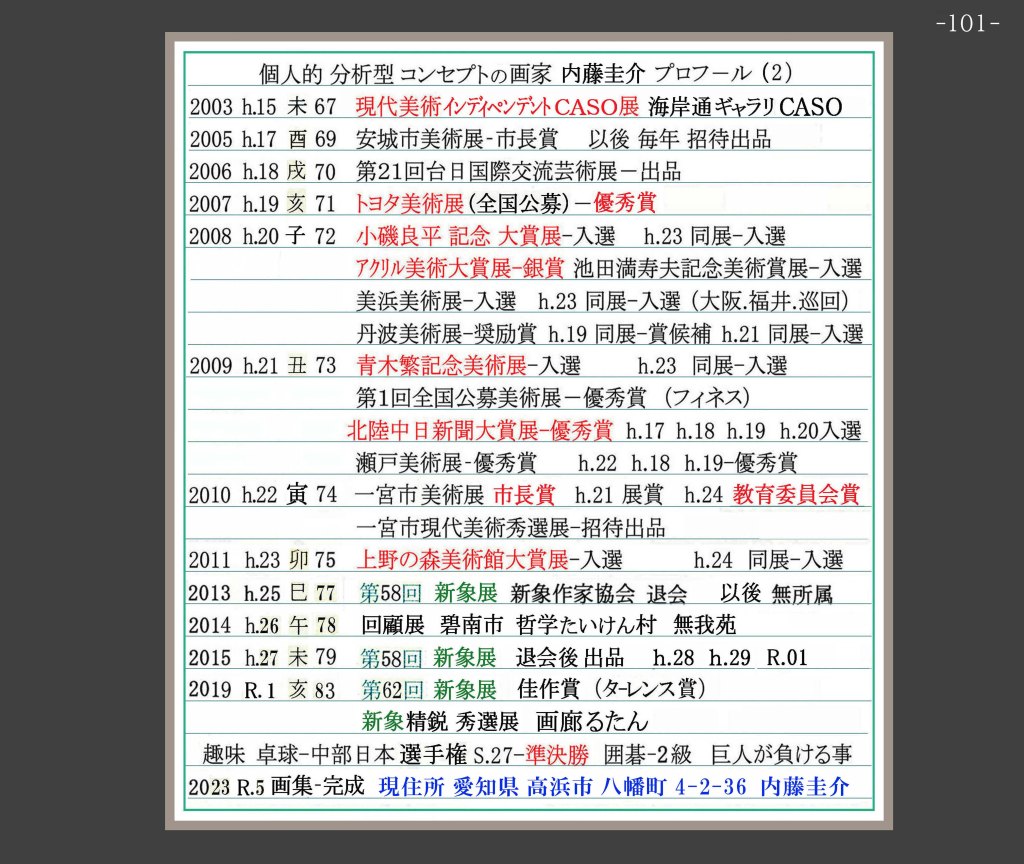
2003 (Year of the Sheep), age 67: Contemporary Art Independent CASO Exhibition at Kaigan-dori Gallery CASO.
2005 (Year of the Rooster), age 69: Received the Mayor’s Award at the Anjo City Art Exhibition; subsequently invited to exhibit annually.
2006 (Year of the Dog), age 70: Exhibited at the 21st Taiwan-Japan International Exchange Art Exhibition.
2007 (Year of the Boar), age 71: Received the Excellence Award at the Toyota Art Exhibition (National Open Competition).
2008 (Year of the Rat), age 72: Selected for the Ryohei Koiso Memorial Art Museum Grand Prize Exhibition; selected again in 2011.
Received the Silver Prize at the Acrylic Art Grand Prize Exhibition. Selected for the Masuo Ikeda Memorial Art Prize Exhibition.
Selected for the Mihama Art Exhibition; selected again in 2011 (exhibitions touring Osaka and Fukui).
Received the Encouragement Prize at the Tamba Art Exhibition; nominated in 2007; selected for exhibition in 2009.
2009 (Year of the Ox), age 73: Selected for the Aoki Shigeru Memorial Art Exhibition; selected again in 2011.
Received the Excellence Award at the 1st National Open Art Exhibition (sponsored by Finesse)
Received the Excellence Award at the Hokuriku Chunichi Shimbun Grand Prize Exhibition; selected in 2005, 2006, 2007, and 2008
Received the Excellence Award at the Seto Art Exhibition; received the same award again in 2010, 2006, and 2007.
2010 (Year of the Tiger), age 74: At the Ichinomiya City Art Exhibition, received the Mayor’s Award; also received the exhibition award in 2009 and the Board of Education Award in 2012.
Invited to exhibit at the Ichinomiya City Contemporary Art Select Exhibition.
2011 (Year of the Rabbit), age 75: Selected for the Ueno Royal Museum Grand Prize Exhibition; selected again in 2012.
2013 (Year of the Snake) age 77: Exhibited at the 56th Shinsho Exhibition; resigned from the Shinsho Artists Association, independent thereafter.
2014 (Year of the Horse), age 78: Retrospective Exhibition at Philosophy Experience Village Mugaen in Hekinan City.
2015 (Year of the Sheep), age 79: Exhibited at the 58th Shinsho Exhibition after resignation from the Shinsho Artists Association; also exhibited in 2016, 2017 and 2019.
2019 (Year of the Boar), age 83: Received Honorable Mention (Talens Prize) at the 62nd Shinsho Exhibition.
Shinsho Outstanding Selection Exhibition at Gallery Rutan
Hobbies: Table tennis(reached semifinals in the Chubu Japan Championship, 1952); Go – 2nd kyu; reveling in the Giants’ losses.
2023: Art Book Completed
Keisuke Naito — Current address: 4-2-36 Hachiman-cho, Takahama City, Aichi Prefecture

I would be very grateful if you would send me your opinions, thoughts, or other feedback.
Keisuke Naito
4-2-36 Hachiman-cho, Takahama City, Aichi Prefecture 444-1302, Japan
Printing and Binding
Suzuoki Printing Co., Ltd.
5-203 Ikeda-cho, Kariya City, Aichi Prefecture 448-0044, Japan
 How to paint strange pictures